Challenge #2: Invasive Flora and Fauna
SANBI – the South African National Biodiversity Institute – states: “Biological invasions are a large and growing concern—globally and in South Africa. Many thousands of species have been translocated from their native ranges to novel environments, where some have become invasive. Biological invasions threaten native biodiversity, reduce the ability of ecosystems to deliver vital services like adequate water supply, and have direct negative impacts on the well-being of millions of people by threatening their health and the country’s rural economy.”
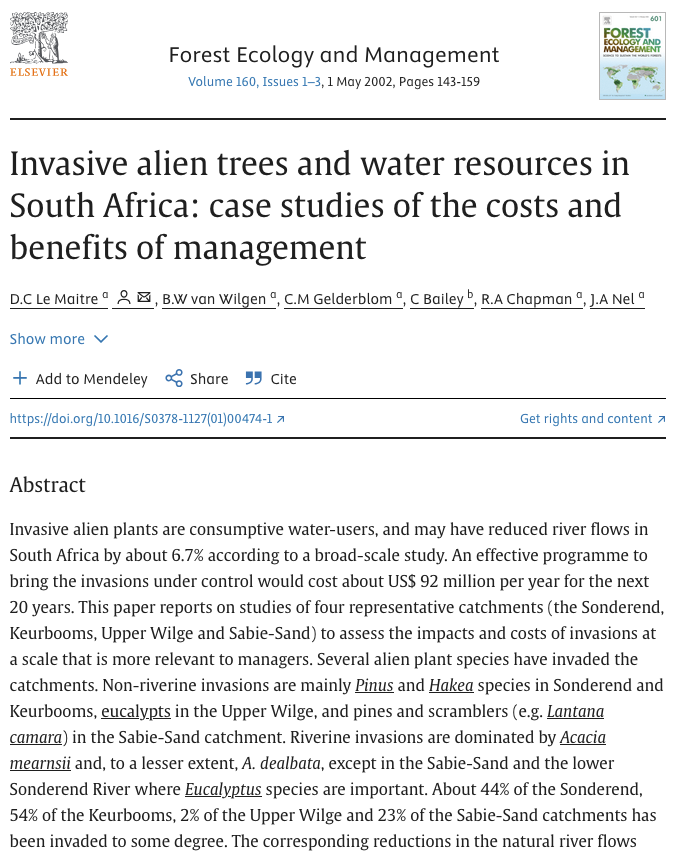
Among other, invasive alien plants (AIS) are consumptive water-users. By 2002 they may already have reduced river flows in South Africa by about 6.7% according to a broad-scale study. At that time an effective programme to bring the invasions under control countrywide would have cost about US$ 92 million per year for the next 20 years.
The 2002 situation: A projection of the impact of AIS on the Keurbooms River catchment area
In a 2002 scientific paper D.C. LeMaitre et al. reported on studies of four representative catchments (the Sonderend, Keurbooms, Upper Wilge and Sabie-Sand). In these studies researchers had assessed the specific impacts and costs of invasions in these four areas. It was found that in the Keurbooms non-riverine invasions were mainly Pinus and Hakea species whereas the riverine invasions were dominated by Acacia mearnsii (black wattle).
Moreover, by 2002 some 54% of the Keurbooms catchment had already been invaded to some degree. The corresponding reduction in the natural river flow attributed to these invasions was about 22%. If left uncontrolled, alien invasive plants could potentially spread and occupy 77% of the Keurbooms catchment by 2030. This would then reduce the water flow by up to 95.5%.
The cost implications of letting the AIS spread uncontrolled were found to be severe: Should the catchments of the Keurbooms be allowed to become fully invaded, by 2030 the projected cost for AIS removal would be some US$ 20.5 million which equivalates R 336 million. Clearly, the projected impacts would justify control programmes aimed at clearing alien invaders if only for water conservation.
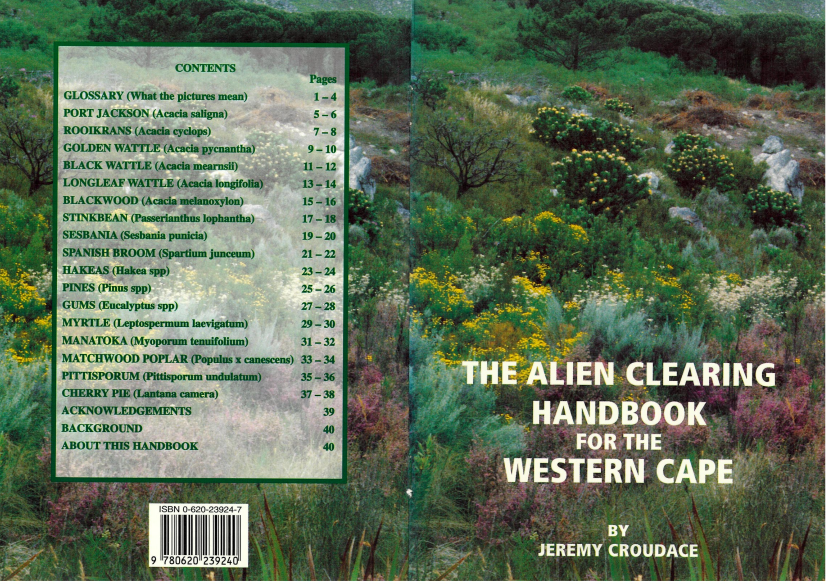
If you want to become active in AIS removal and control you might find Jeremy Croudace’s “Alien Clearing Handbook for the Western Cape” useful – you can download it here.
The 2025 situation: Where do we stand 20 years later?
The South African government has implemented legislation to deal with biological invasions, and has invested substantially in biosecurity and control measures to prevent biological invasions and mitigate their impacts. The Department of Forestry, Fisheries and the Environment spent over 1.5 billion Rand between 2020-2023 to control invasions, but money is also spent by other governmental agencies, NGOs and private individuals.
SANBI — the South African National Biodiversity Institute — is mandated, in terms of the National Environmental Management: Biodiversity Act of 2004 and its Regulations, to report every three years to the Minister on the status of biological invasions and the effectiveness of control measures.
The report acts to improve the links between policy, on-ground management, research, and monitoring and evaluation. It thus helps inform the development and ongoing adaptation of appropriate policies and control measures, both to reduce the negative impacts of biological invasions, and to retain any benefits of invasive species where desirable and possible.
The first report was released in 2018, and the second in 2021. The third report is now available and you can download it here.
The report provides details on: 1) the pathways along which alien species are introduced and move around the country; 2) the status and impacts of over 3 500 alien species; at least a third of which are invasive; 3), the degree to which sites are invaded and impacted; 4) the effectiveness of the full range of interventions that South Africa has used to address the problem; and 5) the status and management of invasions on the Prince Edward Islands (South Africa’s sub-Antarctic territory).
Join our mission. Volunteer, donate, advocate. Get involved today.
Plettenberg Bay Community Environmental Forum is a non-profit organisation
PBO #930023744 / 38 Hanois Crescent, Plettenberg Bay 6600, South Africa
Imprint & Disclaimer