
Challenge #1: Water Supply
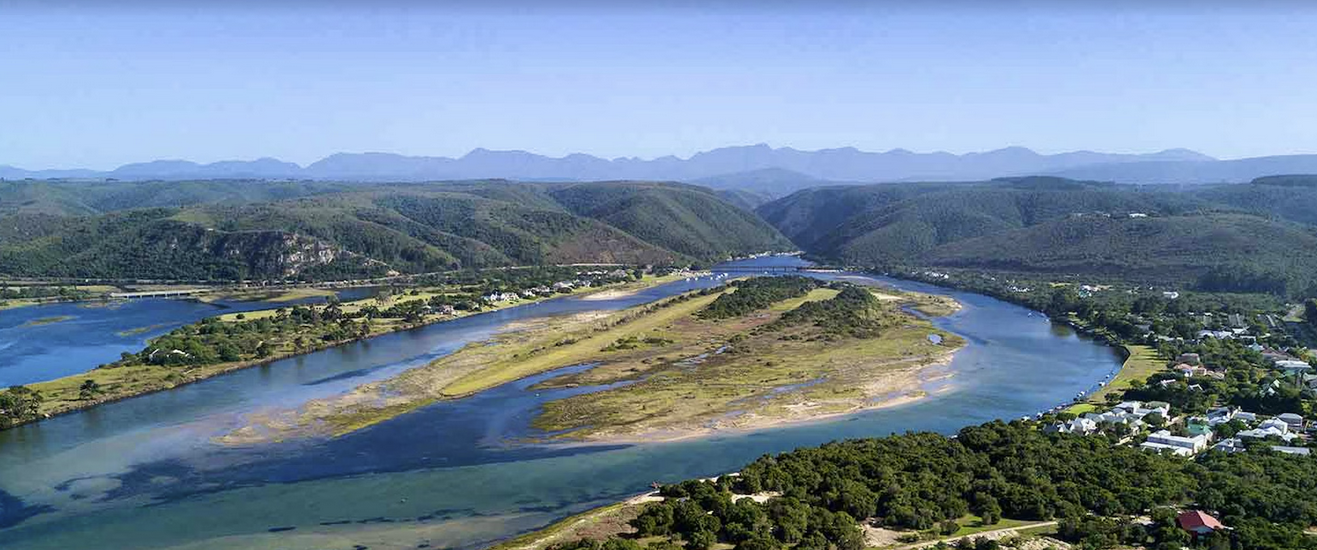
In December 2025 the flow rate of the Keurbooms River once again dropped below the prescribed minimum of 300 liters/second. When the river’s flow drops below this critical point, the Bitou Municipality must stop water extraction to preserve the ecological health of the important Keurbooms Estuary and surrounding riverine system. Already in October 2025 the level of the Roodefontein Dam (our town’s major storage dam) had dropped to 47.7 %. As a consequence water restrictions were then implemented.
The limitation of our water supply is by no means a new problem. Almost 20 years ago the Gouritz State of the Rivers Report (GSRR) already listed the characteristics, benefits and issues associated with the rivers of the Southern Cape.
Frighteningly, indications are that South Africa will reach its limits of accessible water supply between 2020 and 2030. Locally, water resources in the Garden Route are under severe threat and that water demand is unsustainable. Water Affair’s Internal Strategic Perspective for the Gouritz Water Management Area (which incorporates the rivers of the Southern Cape) indicates a shortfall of 43 million cubic metres per annum for the Garden Route and 10 million cubic metres per annum for the Knysna to Bloukrans area.
Clearly there is a need for us all to take heed, save water, implement stringent water regulations and more sensible water harvesting techniques.
The Keurbooms system is Plettenberg Bay’s main water source and its estuary is ranked as 18th in terms of conservation importance out of 247 estuaries in South Africa. During 2009/2010 water levels in the Keurbooms system dropped alarmingly as a result of the drought with measurements at the Keurboom’s gauging weir at times dropping below the determined ecological requirement to sustain the Keurbooms Estuary – this despite water cuts and water use regulations being imposed by the Bitou Municipality.
Bitou’s water crisis receives ongoing attention by the Plett Ratepayer’s Association who regularly report on this issue and try to engage constructively with the Municipality. Visit the Association’s website for further information:
In October 2008 the Plettenberg Bay Community Environment Forum (PBCEF) commissioned Grant Johnstan and Associates to draft an Evironmental Management Framework (EMF). The report titled “The Lower Bitou / Keurbooms Catchment & Floodplain Preliminary Environmental Management Framework” aimed to raise awareness of critical / sensitive environments occuring in our area by identifying and mapping the various ecosystems.
Identified threats to the river systems in our area include the following:
- Invasive alien plants
- Water abstraction and flow modification
- Alien fish
- Agricultural practices
- Urban development
- Water quality
Other important river systems in our area include the Salt River in the Crags (to the east of Plettenberg Bay) and the Bitou system.
Research on the Salt River has revealed that the system is home to 33 newly discovered, undescribed aquatic insect species and four new genera which have an ancient lineage going back more than 140 million years. The Salt River is a fishless system and, it is believed, that because of this, these seemingly unique species have not had to adapt to predation through evolution. The Nature’s Valley Trust, in partnership with the Albany Museum and SANParks are continuing with research and conservation projects involving the Salt River and eleven other rivers in the Tsitsikamma.
The Bitou River is only approximately 15km long, but is vitally important to the Keurbooms Estuary which it feeds. The Bitou Wetland has been described as “the most valuable ecological resource of the entire catchment, the Bitou marsh, 654ha in entirety and currently under severe threat of development on its perimeter ….” (The Wetlands Of The Greater Keurbooms River Catchment: Identification, Mapping and Preliminary Present State Assessment, EH Haigh, Institute for Water Research, Rhodes University, 2005). A conservation and rehabilitation investigative project is currently being implemented by the Eden to Addo Corridor Initiative in the Bitou Valley and includes community involvement and eco tourism.